
When we started atdepth in 2021, we bet on Oceananigans.jl, a relatively new GPU-accelerated ocean modeling code with only 7 peer-reviewed papers to its name. Today, that number stands at 40+ publications from research groups worldwide, and we are actively supporting the code’s evolution by providing testing infrastructure.
The Bottom Line
Academic validation proves Oceananigans models ocean physics correctly. Continuous integration proves it does so reliably, repeatedly, and at scale. We're investing in both.
Here is why we made that choice and why we’re doubling down.
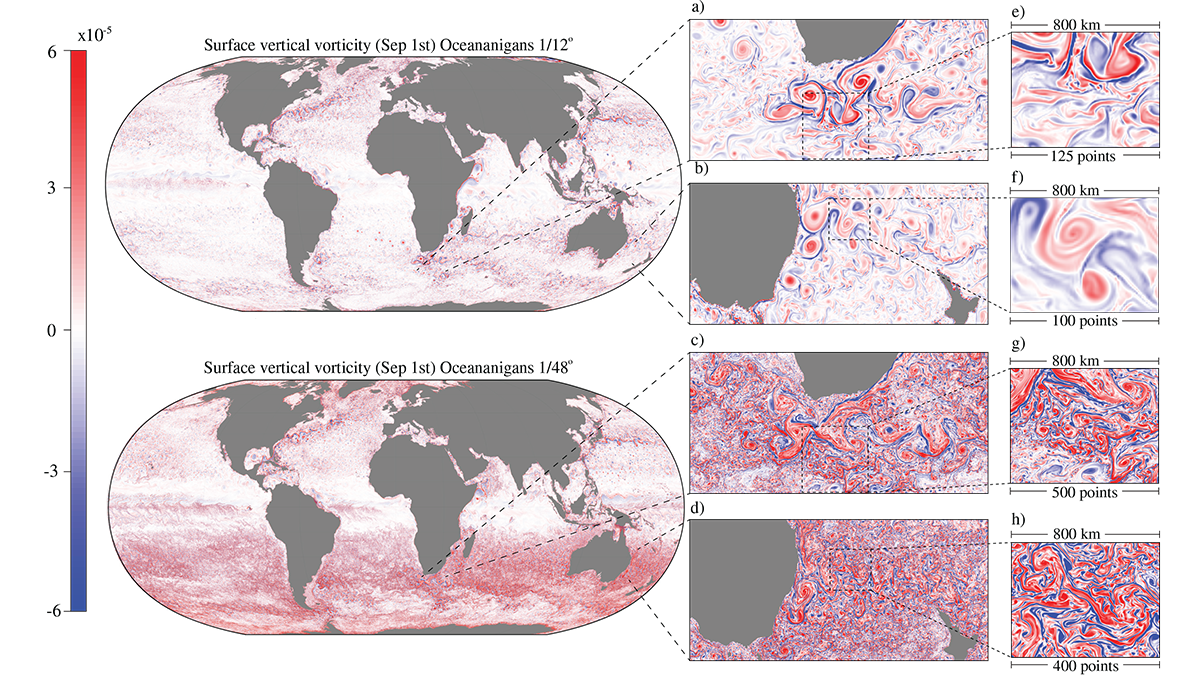
Oceananigans.jl offers breakthrough performance, enabling operational ocean modeling at unprecedented scales and resolutions. Credit: Silvestri et al. [2025], Figure 1
Scientific Validation Through Peer Review
Oceananigans.jl has demonstrated scientific credibility and skill across diverse applications:
Research Applications
When researchers at MIT, Scripps, Cambridge, Oxford, and many other universities worldwide stake their publications on Oceananigans, they are providing the strongest form of validation: independent verification through rigorous peer review.
From Research Code to Production Platform: The CI Gap
Emergence of ocean modeling codes in new ocean industries creates a new challenge for traditional ocean modeling codes: extensive use does not guarantee production reliability. ROMS and MITgcm have decades of academic citations, but lack the systematic continuous integration (CI) testing that modern software engineering demands.
Academic codes excel at producing novel research results. Production platforms require something different: automated testing that catches regressions, validates performance across hardware configurations, and ensures stability under operational conditions.
This is exactly the gap that continuous integration fills—and it is largely absent from legacy ocean modeling codes.
atdepth now provides the CPU and GPU testing infrastructure for Oceananigans.jl’s continuous integration pipeline. Every commit to Oceananigans runs through Nautilus, atdepth’s GPU-powered server, catching issues before they reach production deployments.
Strategic Investment
By hardening Oceananigans through systematic CI, we are building the foundation that operational ocean intelligence requires. The benefits flow to the entire ocean modeling community that is increasingly using Oceananigans.
Why This Matters for Ocean Intelligence
Academic validation proves Oceananigans models ocean physics correctly. Continuous integration proves it does so reliably, repeatedly, and at scale.
By supporting Oceananigans’ CI infrastructure, we are helping bridge that gap. Not just for atdepth’s Ocean Digital Twins, but for anyone building operational applications on this codebase.
Key Technology
Interested in how atdepth uses Oceananigans for operational Ocean Digital Twins? Get in touch.